Inventory forecasts that shifted purchasing decisions.
A forecasting workflow for stock risk, margin pressure, and purchase timing, delivered within the team’s existing environment.
Talha identified what wasn't worth building and delivered the tool that shifted my purchasing decisions.
— Priya Krishnan, Founder, Retina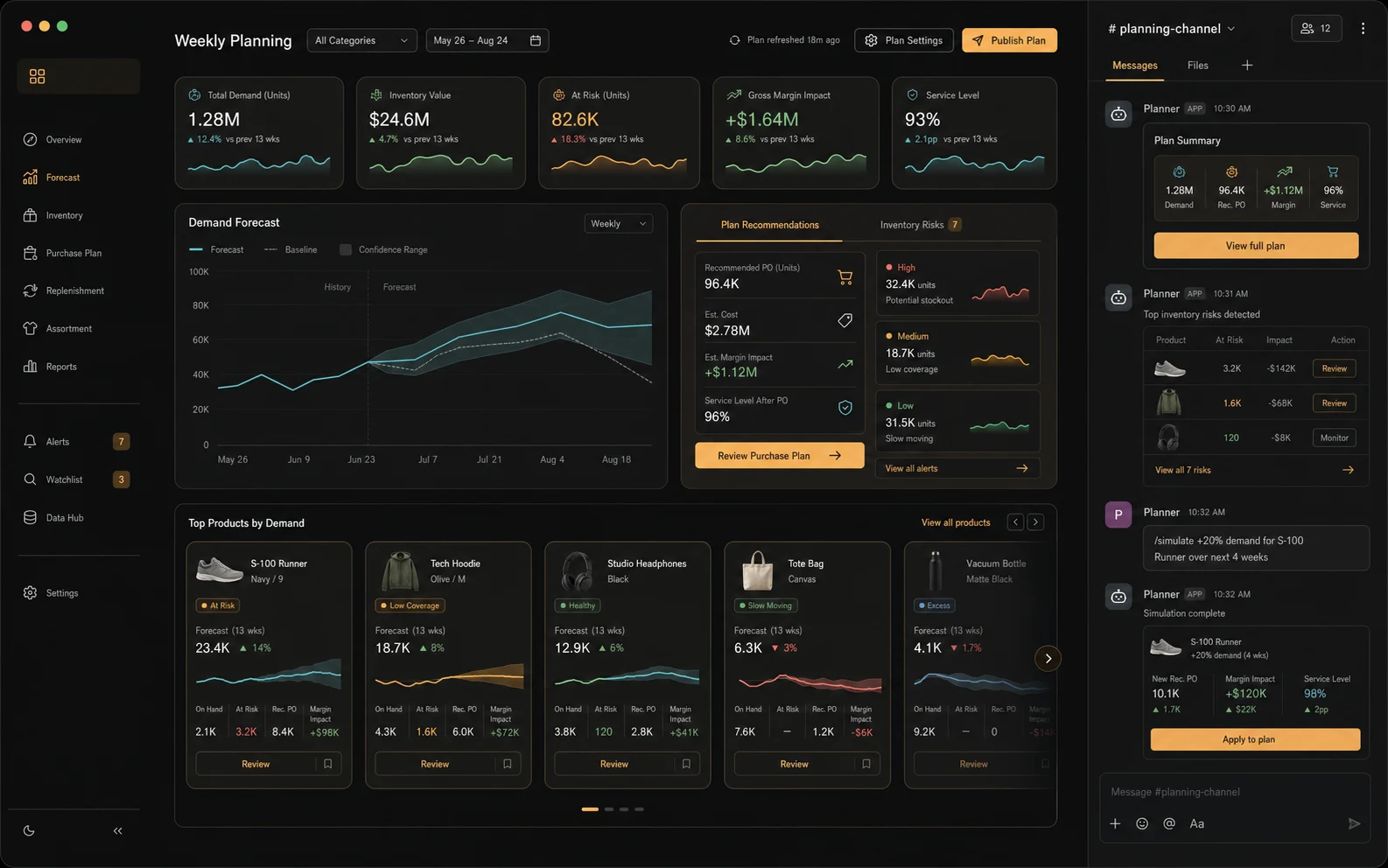
Across top products
Per-product improvement
Weekly buying rhythm
Planning target hit
The business outgrew intuition‑driven buying.
Quarterly planning can’t keep pace with promotions, supplier delays, or shifting demand. Retina needs a repeatable process to choose the next purchase.
Quarterly buying couldn’t keep up with promo swings, supplier delays or demand shifts.
The team needed a repeatable decision workflow, not another report.
Each recommendation required a confidence range and a clear reason.
The workflow had to live in the tools where the team already plans and decides.
We turned forecasting into a weekly planning workflow.
The model merges sales, inventory, promotions and lead times, then sends risk flags and purchase recommendations to Slack.
- Sales, inventory, promotions, and supplier lead times in one forecast.
- Confidence ranges attached to each recommendation.
- Stockout risk surfaced before buying windows closed.
- Slack became the planning surface for weekly decisions.
Weekly cadence
Forecasting was tied to the rhythm of real buying decisions.
Slack surface
Recommendations appeared where the team already worked.
Risk flags
Stockout risk became visible before orders were placed.
Confidence ranges
Each recommendation showed enough context to support judgment.
Simple model proof
Baselines and checks kept the forecast explainable.
Decision support
The founder kept final control while the model became the planning baseline.
Data audit
Reviewed sales, inventory, promotions, and supplier lead times.
Clean pipeline
Built the planning table and stockout flags.
Forecast tests
Compared simple baselines against stronger models.
Buying logic
Added confidence ranges, risk flags, and purchase guidance.
Slack workflow
Moved recommendations into the planning channel.
Launch + tune
Shipped the workflow and adjusted it through the first cycle.
- Sales
- Ads spend
- Inventory
- Suppliers
- Promotions
- Lead times
- Seasonality
- Stockout flags
- Model
- Checks
- Ranges
- Alerts
- Slack app
- Risk flags
- Buy recs
- Exports
The model mattered only after it altered the buying cadence. Slack became the product surface since the team already decides there.
Better buying rhythm: quarterly decisions became weekly planning with confidence ranges attached.
Measured inventory impact: top-product stockouts dropped 31% and margin per product improved 18% after two buying cycles.
Talha identified what wasn't worth building and delivered the tool that shifted my purchasing decisions.
- Sales history
- Inventory levels
- Promotions
- Supplier lead times
- Demand cleanup
- Stockout flags
- Seasonality
- Product checks
- Forecast ranges
- Risk scores
- Buy quantities
- Planning notes
- Slack workflow
- Weekly alerts
- Exports
- Review history
- Human approval
- Model checks
- Data refreshes
- Decision logs
Got a problem AI might solve? Let's find out.
30 minutes. Free. No NDA needed. You leave with a clear yes-or-no on whether to build — and a one-pager you can forward to your team the same day.